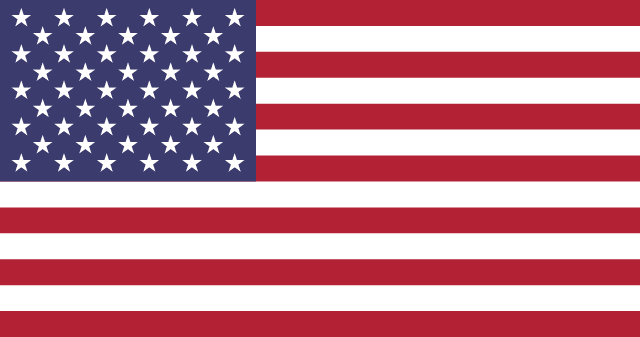
United States Flag
How to identify it
Thirteen alternating red and white horizontal stripes with a blue rectangle in the upper flagpole corner containing 50 small white stars in nine offset rows. Counting stripes and stars distinguishes it from similar designs.
Design and construction
- Proportions
- 10:19 for flags manufactured for the federal government
- Adoption and legal status
- 4 July 1960, when the 50th star was added for Hawaii
- Construction
- Executive Order 10834 (1959) fixes the proportions of the blue corner panel, the stripe widths and the exact star positions: nine rows of stars alternating six and five.
Officially documented meaning
Federal law (4 U.S.C. §1) prescribes thirteen stripes for the original states and one star for each current state, but it assigns no meaning to the colours.
Commonly repeated interpretation
Not official: Red for valour, white for purity and blue for justice is repeated everywhere. It comes from Charles Thomson's 1782 report on the Great Seal of the United States, not from any law about the flag.
History of the design
The Flag Resolution of 1777 set thirteen stripes and thirteen stars without fixing their arrangement, so early flags vary widely. After two extra stripes were added for Vermont and Kentucky, an 1818 act returned the stripe count to thirteen permanently and made the star count follow the number of states. The present arrangement is the 27th official version.
Similar flags
Compare the details that separate these designs.


Sources
References for the design and any additional notes on this page.
- 4 U.S. Code §1: Flag; stripes and stars on; Legal Information Institute, Cornell Law School
- United States: flag history and construction sheets; Flags of the World (FOTW)