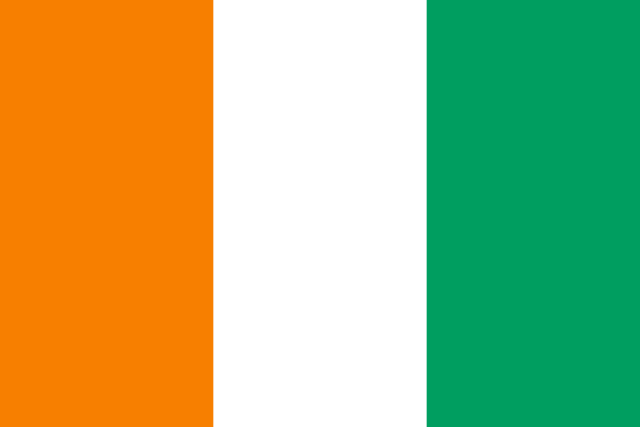
Ivory Coast Flag
How to identify it
Three equal vertical bands of orange, white and green in a 2:3 rectangle. Orange sits next to the flagpole; Ireland begins with green and uses a longer 1:2 shape.
Design and construction
- Proportions
- 2:3
- Adoption and legal status
- 1959, before independence from France in 1960
- Construction
- Three equal bands. Commonly published colour references give PMS 151 for the orange and PMS 347 for the green.
Commonly repeated interpretation
Not official: The orange is usually explained as the savannah of the north, the white as peace and the green as the forests of the south. The reading is standard in reference works rather than set out in law.
History of the design
The territory flew the French tricolour until it became an autonomous republic within the French Community in 1958; the orange-white-green tricolour followed in 1959 and was kept at independence.
Similar flags
Compare the details that separate these designs.
 Ireland
Ireland reverses the bands (green next to the flagpole) and is longer at 1:2.
Comparison guides
Sources
References for the design and any additional notes on this page.
- Ivory Coast: adoption, proportions and colour references; Flags of the World (FOTW)