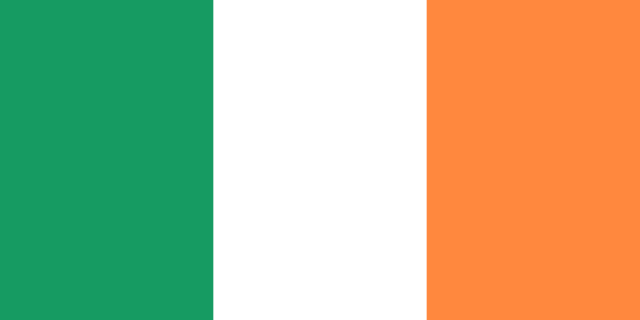
Ireland Flag
How to identify it
Three equal vertical bands of green, white and orange on a 1:2 rectangle. Green sits next to the flagpole; Ivory Coast begins with orange and uses a shorter 2:3 shape.
Design and construction
- Proportions
- 1:2 ("twice as wide as it is high")
- Adoption and legal status
- Used from 1848, adopted by the Irish Free State in 1922 and confirmed in Article 7 of the 1937 Constitution
- Construction
- The Department of the Taoiseach states that the three colours are of equal size and that the green goes next to the flagstaff.
Officially documented meaning
Government guidance states that the tricolour is intended to symbolise the inclusion of, and the aspiration for unity between, people of different traditions on the island.
Commonly repeated interpretation
Not official: Green for the nationalist tradition, orange for the Orange tradition and white for peace between them follows Thomas Francis Meagher, who in 1848 described the white as "a lasting truce between Orange and Green".
History of the design
Meagher first flew the tricolour at Waterford on 7 March 1848. It was flown over the GPO during the 1916 Rising, became the Free State flag in 1922, and was confirmed in the Constitution in 1937.
Similar flags
Compare the details that separate these designs.
 Ivory Coast
Ivory Coast is the mirror image: orange next to the flagpole, green at the outer edge, and shorter at 2:3.
 India
IndiaIndia is horizontal, with a navy-blue 24-spoke wheel in the white band.
Comparison guides
Sources
References for the design and any additional notes on this page.
- The National Flag; Department of the Taoiseach (gov.ie)
- The National Flag: description and protocol; Óglaigh na hÉireann / Irish Defence Forces