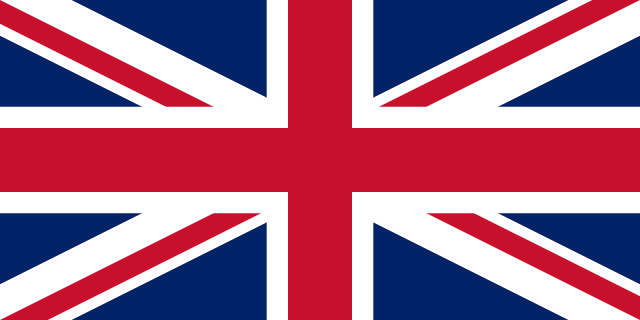
United Kingdom Flag
How to identify it
A blue field with a broad upright red cross edged in white. Behind it, diagonal red stripes sit unevenly within wider white stripes. That uneven spacing means the flag has a correct way up.
Design and construction
- Proportions
- 1:2 at sea, 3:5 on land in common British usage
- Adoption and legal status
- 1 January 1801, when Ireland joined the union
- Construction
- The diagonal red cross of St Patrick is offset within the wider white diagonal cross of St Andrew. In the upper flagpole corner, the broad white stripe sits above the red one; the order reverses in the opposite corners.
Officially documented meaning
The design combines the crosses associated with St George (England), St Andrew (Scotland) and St Patrick (Ireland).
Commonly repeated interpretation
Not official: The name Union Jack is sometimes said to apply only at sea. British institutional usage treats Union Jack and Union Flag as interchangeable on land.
History of the design
The first union flag of 1606 joined the English and Scottish crosses after the Union of the Crowns. The Irish saltire was added in 1801. Wales is not represented, because it was already legally joined to England when the first union flag was drawn.
Similar flags
Compare the details that separate these designs.
 Australia
Australia adds six white stars to its blue field, including a large star below the Union Flag; the United Kingdom has neither the blue field nor those stars.
Sources
References for the design and any additional notes on this page.
- The Union Jack; The Royal Family (royal.uk)
- United Kingdom: flag history and construction sheets; Flags of the World (FOTW)