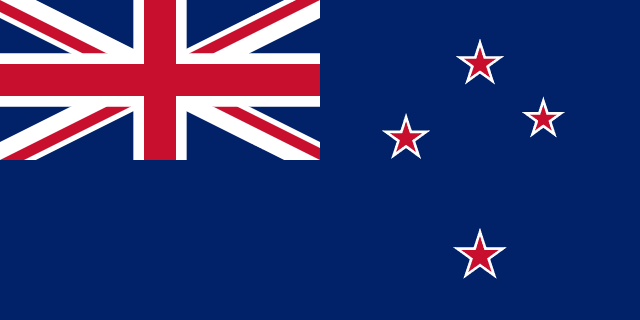
New Zealand Flag
How to identify it
A blue field with the Union Flag in the upper flagpole corner and four red, white-edged stars forming the Southern Cross on the outer half. Australia has six white stars in total, including a large one below the Union Flag.
Design and construction
- Proportions
- 1:2
- Adoption and legal status
- In use as the New Zealand Ensign from 1902; declared the New Zealand Flag by the Flags, Emblems, and Names Protection Act 1981
- Construction
- Section 5 of the 1981 Act declares the flag to be the ensign depicted in Schedule 1 of the Act, which carries the authoritative drawing of the canton and the four stars.
Officially documented meaning
Official material describes the flag as the symbol of the realm, government and people of New Zealand; the Act itself assigns no colour symbolism.
History of the design
A New Zealand ensign defaced with the Southern Cross was authorised in 1869 for government ships and became the national flag in 1902. A two-stage referendum in 2015–16 on replacing it returned a majority for keeping the current design.
Similar flags
Compare the details that separate these designs.
 Australia
Australia has six white stars: five in the Southern Cross and a large seven-pointed Commonwealth Star below the Union Flag. New Zealand has four red stars and no star in that lower corner.
Comparison guides
Sources
References for the design and any additional notes on this page.
- Flags, Emblems, and Names Protection Act 1981, s 5; New Zealand Legislation (legislation.govt.nz)
- New Zealand flag: Te kara o Aotearoa; Manatū Taonga / Ministry for Culture and Heritage