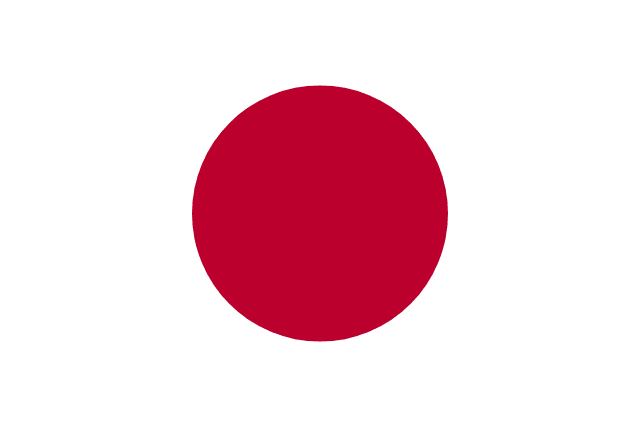
Japan Flag
How to identify it
A plain white field with one red disc exactly in the centre. It has no border, rays or other emblem. Bangladesh and Palau place their discs slightly toward the flagpole side and use coloured fields.
Design and construction
- Proportions
- 2:3
- Adoption and legal status
- 13 August 1999, when the Act on National Flag and Anthem gave the design statutory form
- Construction
- The disc is centred and its diameter is three fifths of the flag's height.
Officially documented meaning
The 1999 Act specifies the geometry and the colours (white and crimson) but states no symbolic meaning.
Commonly repeated interpretation
Not official: The disc is widely understood as the sun, matching the name Nisshōki, meaning sun-mark flag, and the nickname Hinomaru, meaning circle of the sun.
History of the design
Sun discs appear on Japanese banners for centuries. An 1870 Meiji regulation prescribed a 7:10 flag with the disc shifted one hundredth of the length toward the flagpole side; the 1999 Act moved the disc to the true centre and changed the proportions to 2:3.
Similar flags
Compare the details that separate these designs.
 Bangladesh
Bangladesh uses a dark green field and places its red disc off-centre toward the flagpole side.
 Palau
PalauPalau uses a light blue field with an off-centre yellow disc.
Comparison guides
Sources
References for the design and any additional notes on this page.
- Japan: flag history and construction sheets; Flags of the World (FOTW)