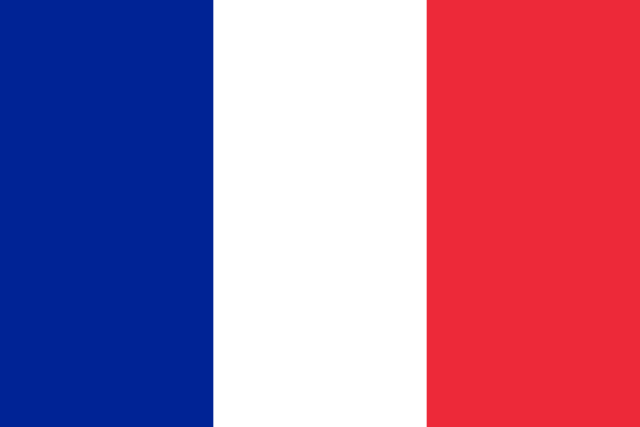
France Flag
How to identify it
Three equal vertical bands, blue next to the flagpole, then white, then red. Vertical orientation separates it from the Netherlands and Russia; the blue-first order separates it from Italy and Ireland.
Design and construction
- Proportions
- 2:3
- Adoption and legal status
- 15 February 1794 for the current band order
- Construction
- Three vertical bands of equal width.
Commonly repeated interpretation
Not official: Blue and red are usually described as the colours of Paris and white as the colour of the monarchy, brought together during the Revolution. Presentations of this vary, and no colour symbolism is fixed in the constitution, which names only the tricolour itself.
History of the design
Early revolutionary flags placed red next to the flagpole; the order was reversed in 1794. Naval and land versions have differed in the exact width of the bands. In 2020 French state buildings returned to a darker navy blue, reversing a lighter shade introduced in the 1970s for television.
Similar flags
Compare the details that separate these designs.
 Netherlands
The Netherlands uses the same three colours in horizontal bands, red on top.
 Italy
ItalyItaly is also vertical but green, white and red.
Sources
References for the design and any additional notes on this page.
- France: flag history and construction sheets; Flags of the World (FOTW)