All flags A–Z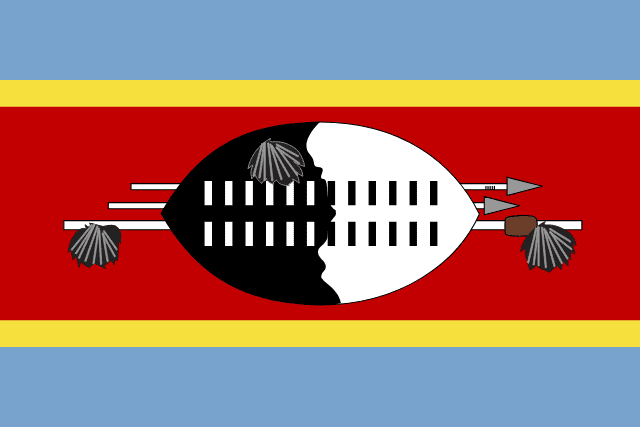
Eswatini Flag
Share:
Blue
Yellow
Red
Black
White
Emblem
Horizontal Stripes
How to identify it
Blue, yellow-edged crimson, blue horizontal bands with a black-and-white Nguni shield lying sideways across the centre, backed by two spears and a staff.
Design and construction
- Proportions
- 2:3
- Adoption and legal status
- Designed by King Sobhuza II, based on a military flag he gave the Swazi Pioneer Corps in 1941, first hoisted 25 April 1967, registered by the College of Arms in London on 30 October 1967, and formally adopted as the national flag under the Flags and Coat of Arms Act on 6 October 1968 at independence from the United Kingdom.
- Construction
- Five horizontal bands of blue, yellow, crimson (triple width), yellow and blue, with a black-and-white Nguni shield lying across the centre, backed by two spears and a feather-tasselled staff (injobo).
Officially documented meaning
Blue stands for peace and stability, yellow for the country's resources, and crimson for past battles; the shield and spears symbolise protection from enemies, and the shield's black-and-white colouring is said to represent the peaceful coexistence of Black and white residents.
Sources
References for the design and any additional notes on this page.
- Swaziland Flags and Coat of Arms Act, 1968; EswatiniLII
- Flag of Eswatini; Wikipedia