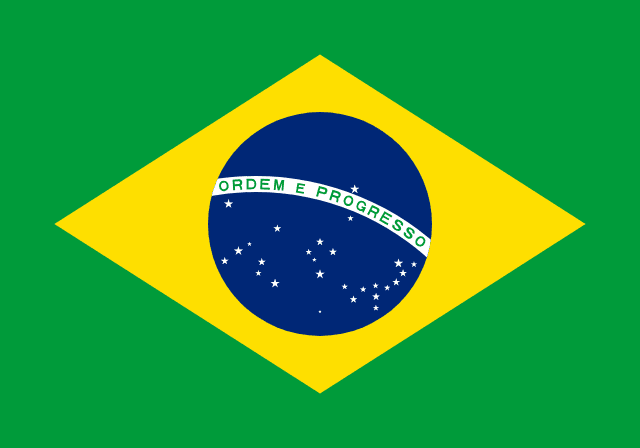
Brazil Flag
How to identify it
A green field with a large yellow rhombus and a dark blue globe carrying white stars and a curved white band reading ORDEM E PROGRESSO.
Design and construction
- Proportions
- 7:10
- Adoption and legal status
- 19 November 1889, with star updates through 1992
- Construction
- Law 5.700 of 1971 sets the geometry in modules and lists the stars, their magnitudes and their positions.
Officially documented meaning
The blue globe reproduces the sky over Rio de Janeiro on the morning of 15 November 1889, the day the republic was proclaimed. Each star stands for a state or the Federal District; the count is 27 today.
Commonly repeated interpretation
Not official: Green for forests and yellow for gold is the usual explanation. The historical link runs through the dynastic colours of the houses of Braganza and Habsburg used under the empire.
History of the design
The imperial flag had the same green field and yellow rhombus with a crowned coat of arms; four days after the republic was declared the arms were replaced by the celestial globe and the positivist motto. Stars have been added as new states were created, most recently in 1992.
Sources
References for the design and any additional notes on this page.
- Lei nº 5.700 de 1º de setembro de 1971 (national symbols law); Presidência da República, Brazil
- Brazil: flag history and construction sheets; Flags of the World (FOTW)